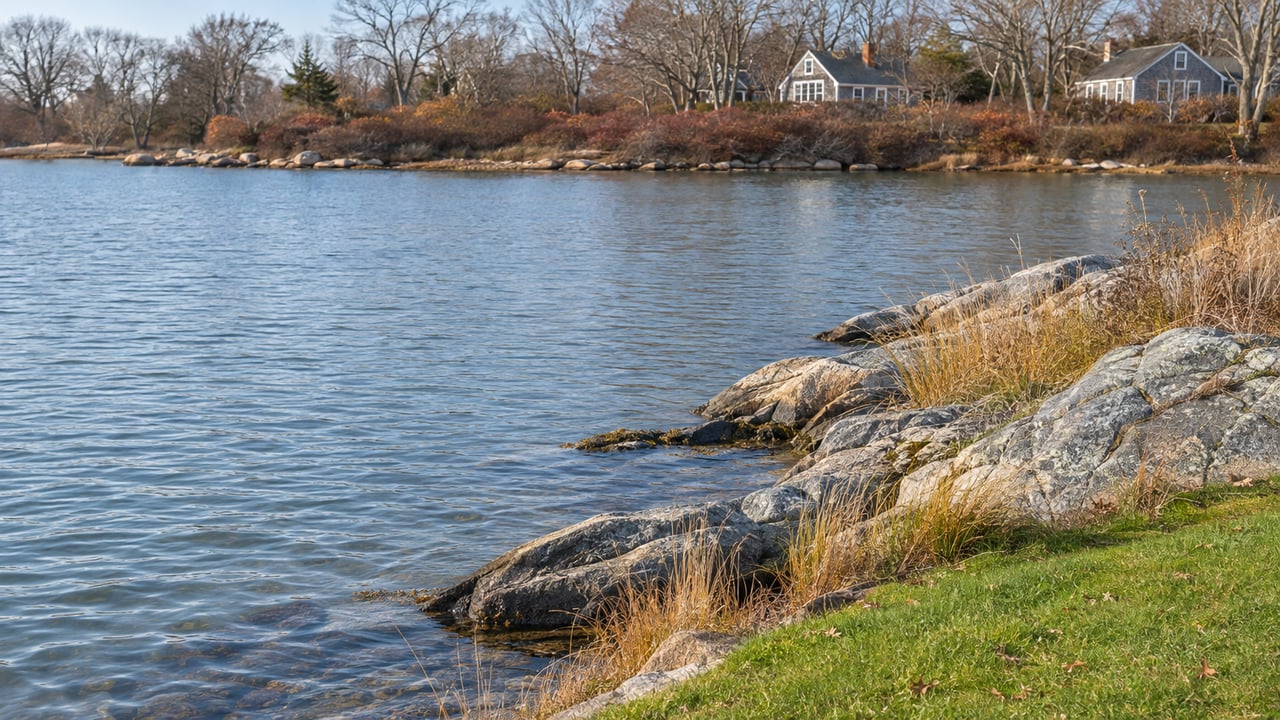
The fields at Daniel Webster Wildlife Sanctuary off Winslow Cemetery Road are kept the way they are by people. The grass the owls hunt over was planted. The ground under it was cut off from the tide more than 150 years ago. Today it stays open because someone mows it on a schedule, and one of the reasons written down for that schedule is to keep raptors coming back each winter.
That history explains why a late-afternoon walk here in December can include something most of Massachusetts rarely sees. A Short-eared Owl, a species the state lists as Endangered, works low over a hayfield in the last light.
The tide stopped coming in during 1872
According to Mass Audubon's Important Bird Area profile for the sanctuary, almost all of the sanctuary sits inside a human-made polder of about two square miles. It was created in 1872, when the Green Harbor River was diked. Water could still drain out of the marshes, but the tide could no longer flow back into the basin. The dike was built to make farmland, and the profile says the land has been farmed ever since. Over the following decades the basin changed from a saltwater system to a freshwater one.
The sanctuary's name reaches back further than the dike. The Daniel Webster Estate's history records that Webster bought a 160-acre farm in Marshfield in 1832, farmed it, and later expanded the estate. Part of the Webster Estate is now Mass Audubon property.
So the sanctuary carries a farmer's name and sits on reclaimed farmland, and both facts bear on the birds. Short-eared Owls winter in coastal areas and extensive grasslands, according to MassWildlife. In 1872 the Green Harbor basin was converted into the kind of habitat these owls look for.
A field kept open on purpose
Grassland on the South Shore fills in with shrubs and then trees if it is left alone. At Daniel Webster, that is held back with mowers. Mass Audubon's profile describes the grasslands as mostly planted European pasture grasses, including timothy, bromes, orchard grass and fescues, along with reed canary grass. The profile names the reasons for the management.
"Mass Audubon has two management goals for the DWWS: 1) grassland breeding birds and 2) wintering raptors."
The profile is undated and was written some years ago, so its figures describe the sanctuary's management at that time. In that account, 70 acres were mowed each year for baling and another 100 acres were mowed each year to keep woody growth from taking hold. A further 52 acres were mowed every second year for the same reason. The profile also notes that the Town of Marshfield is responsible for the dike doors at the river mouth.
The habitat work continues. In a December 2022 update, Mass Audubon described clearing invasive plants from 9 acres of the sanctuary and reseeding the area with more than 18 species. Future mowing was one of the things the project had to plan around.
What the owl is doing over that grass
A mowed field matters to a Short-eared Owl because of how the bird hunts. MassWildlife's species fact sheet, updated April 3, 2025, says the owls that breed farther north arrive in Massachusetts in late fall. They stay in small numbers in suitable habitat through the winter. They forage mostly in early morning and late afternoon, flying about 1 to 10 feet above the ground and sometimes hovering. A bird that hunts a few feet above the ground needs ground it can see into, and that is what the mowed fields give it.
The same fact sheet says no Short-eared Owl nesting has been documented in Massachusetts in recent years. The last known nest was on Tuckernuck Island in 2010. For anyone in Marshfield, then, these owls are winter visitors. The older Important Bird Area profile credited the sanctuary with about 10 percent of the state's wintering Short-eared Owls at the time it was written. The profile calls the species the most significant of the birds of conservation concern the sanctuary hosts.
The owls have company over the same fields. The eBird hotspot list for the sanctuary shows these recent records in 2026:
- Northern Harrier: one bird on January 4, 2026
- Short-eared Owl: two birds on February 4, 2026
- Rough-legged Hawk: one bird on October 28, 2026
These are not new arrivals. In 2022, The Boston Globe's roundup of Mass Audubon sightings reported both a Rough-legged Hawk and a Short-eared Owl at Daniel Webster. A 1994 winter birding guide in Bird Observer listed the same group of species: Rough-legged Hawk, Short-eared Owl, Northern Harrier and Eastern Meadowlark. Sightings are never guaranteed on a given afternoon. The list of species, though, has been stable for more than three decades because the fields have been kept the same.
Where to stand
The sanctuary has more than 3 miles of trails, two observation blinds, viewing platforms and boardwalks, according to Mass Audubon's trail page. For raptors, the trails that matter are the ones that face open ground.
| Trail | Round trip | Why it matters in winter |
|---|---|---|
| Fox Hill Trail | 1.4 miles | Ends at a panoramic observation platform; Northern Harriers are often seen hunting over the marsh |
| Secret Trail | 0.6 mile | Mass Audubon recommends watching for owls and other birds of prey here in winter |
| River Walk | 0.5 mile | Follows the river side of the property |
| Pond Loop | 0.4 mile | Short loop near Webster Pond |
| Piggery Loop | 0.1 mile | The shortest named route |
Some of the best viewing starts right at the car. The 1994 Bird Observer guide suggested scanning the fields from the parking area and looking for Rough-legged and Red-tailed Hawks at Fox Hill. The current trail map marks the parking lot, the viewing areas, Oak Hummock, Webster Pond and Winslow Cemetery. That helps if you want to plan which way to face as the light drops.
The house rules are short. Trails are open daily from dawn to dusk, and admission is free. Dog walking and horseback riding are not allowed, though service animals are welcome, and visitors are asked to stay on the trails. Mass Audubon's bird photography guidance comes down to "Forget the Flash," which matters for a bird that hunts in low light.
Two December afternoons with a naturalist
The owls hunt in fading light, and the sanctuary closes at dusk, so the window is short. Mass Audubon has scheduled two guided outings at Daniel Webster for December 2026. Both require registration, and both meet in the parking lot.
- Birding in a Changing Climate, Thursday, December 3, 8:30 to 10:30 a.m. The fee is $15 for adult members and $18 for nonmembers. Program details are on Mass Audubon's site.
- Short-eared Owl Prowl, Thursday, December 17, 3:30 to 5:30 p.m. Senior Naturalist Doug Lowry leads the walk. The fee is $20 for adult members and $24 for nonmembers, and flash photography is not allowed. The program listing describes standing on an open hilltop as the owls "swoop across the fields in the fading light." It calls Daniel Webster "one of the South Shore's finest spots to watch them hunt."
The owl prowl listing says no birding experience is needed and asks participants to dress for the cold. Sturdy footwear and weather-appropriate layers are part of the instructions. For questions, Mass Audubon lists 781-837-9400 and [email protected].
If you'd like to talk about the parts of town where hayfields, marsh edges and quiet roads still shape daily life, Brita Sheehan is glad to share what she knows. Schedule a complimentary home consultation or get your instant home valuation whenever the timing is right for you.